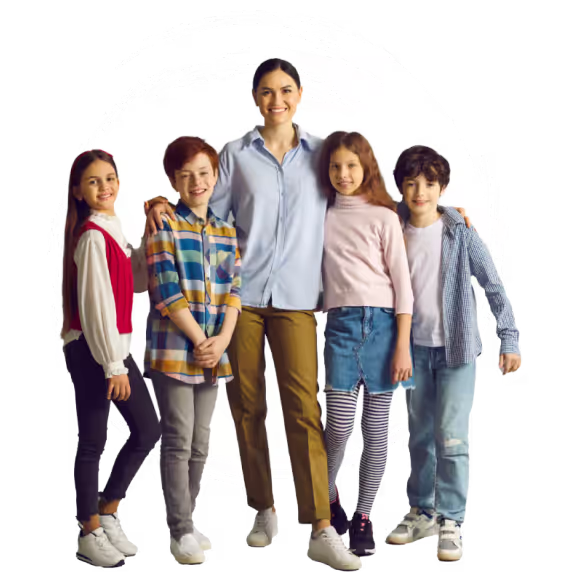
Understanding Visual Modeling within ABA Therapy
Visual modeling stands as a pivotal technique within Applied Behavior Analysis (ABA) therapy, widely used to support children with autism spectrum disorder in acquiring crucial social interaction skills. This article explores the role and impact of visual modeling, including video and peer modeling, as tools to foster communication, social understanding, and independence through structured, personalized visual demonstrations.
Foundations of ABA Therapy for Autism
What is Applied Behavior Analysis (ABA) therapy?
Applied Behavior Analysis (ABA) therapy is an evidence-based approach focused on improving behaviors by understanding their connection to the environment. It uses positive reinforcement to encourage desirable behaviors while reducing less helpful ones. ABA therapy is tailored to each individual, aiming to develop skills in areas such as communication, social interaction, and daily living.
Core principles of ABA
ABA works by breaking down complex behaviors into smaller, manageable steps, making learning easier. Techniques like Discrete Trial Training (DTT) involve structured teaching with repetition and feedback, while naturalistic methods like Pivotal Response Treatment (PRT) promote motivation and generalization of skills. Consistent reinforcement and clear instructions support learning and independence.
Individualized goal-setting and techniques
Each ABA program is customized, focusing on a person's unique strengths and needs. Methodologies include modeling behaviors for imitation, using visual aids such as videos, and incorporating prompting that is gradually faded to build independence. Positive reinforcement strategies, like praise or favorite rewards, play a crucial role in motivating learners. ABA therapy integrates various strategies to ensure skills are effectively acquired and generalized across different settings.
How ABA Therapy Supports Individuals with Autism
Skill development focus
ABA therapy primarily aims to promote skill development in individuals with autism. It targets a broad array of abilities including communication, social interaction, self-care, and academic skills. Therapists break down complex behaviors and tasks into smaller, manageable steps, facilitating easier learning and mastery. This structured approach helps individuals progress incrementally while building confidence in their abilities.
Behavior modification through reinforcement
A cornerstone of ABA therapy is behavior modification using positive reinforcement. Desired behaviors are immediately rewarded with praise, preferred snacks, or visual incentives such as sticker charts. This reinforcement encourages repetition of beneficial actions and gradually reduces challenging behaviors. Techniques like Discrete Trial Training (DTT) and Pivotal Response Treatment (PRT) further enhance learning by using repeated practice and focusing on areas like motivation and social skills.
Environmental influences on behavior
ABA incorporates strategies that consider environmental triggers affecting behavior. Antecedent-Based Interventions (ABI) proactively modify surroundings to prevent problematic behaviors. Natural Environment Teaching (NET) embeds learning opportunities within everyday contexts, supporting generalization of skills. Understanding the antecedents and consequences in an individual's environment is vital to creating sustainable behavior changes.
By combining these methods, ABA therapy helps individuals with autism improve independence, social functioning, and overall quality of life. Through personalized approaches and reinforcement of positive behaviors, it fosters meaningful and lasting development across diverse settings.
Who Provides ABA Therapy? Qualifications and Roles
Who provides ABA therapy and what qualifications do they have?
ABA therapy is delivered by professionals trained specifically in behavior analysis. The primary providers are Behavior Analysts, including Board Certified Behavior Analysts (BCBAs) who hold master's degrees in behavior analysis or related fields. They undergo disciplined coursework, supervised practical experience, and must pass a certification exam administered by the Behavior Analyst Certification Board (BACB).
Registered Behavior Technicians (RBTs) also play an essential role. These technicians work under BCBA supervision to implement therapy strategies directly with clients. RBTs must complete specialized training and certification focused on hands-on intervention techniques.
Importance of trained professionals and transparency
Choosing ABA providers involves ensuring the team is transparent about their credentials and experiences. Ethical practice is upheld by keeping families informed, involving them in goal setting and treatment decisions, and routinely monitoring progress.
High-quality ABA therapy depends on providers who combine professional credentials with individualized care tailored to each learner. This ensures effective support for communication, social skills, and behavior management, empowering children with autism toward greater independence and social participation.
Common ABA Therapy Techniques: From Task Analysis to Modeling

Discrete Trial Training and Natural Environment Teaching
Discrete Trial Training (DTT) is a highly structured ABA technique involving one-on-one teaching sessions where skills are broken down into manageable steps and taught through repeated trials with immediate feedback. This method focuses on clear instructions and reinforcement to build foundational behaviors.
Natural Environment Teaching (NET), on the other hand, integrates learning opportunities within everyday settings. By embedding instruction into natural routines and interactions, NET helps generalize communication and social skills in real-world contexts.
Modeling and Imitation
Modeling plays a crucial role in ABA therapy by demonstrating desired behaviors or skills for individuals, especially children with autism, to observe and imitate. Therapists or caregivers break down complex behaviors into simple steps and provide clear visual cues. Techniques include video modeling—where videos show target behaviors for imitation—and peer modeling, where individuals observe peers exhibiting positive behaviors.
Modeling enhances skill acquisition and generalization, helping individuals transfer learned behaviors across various settings and eventually promoting independence and improved social functioning.
Prompting and Reinforcement Strategies
Prompting provides cues or assistance to encourage the correct response; these prompts are gradually faded to foster independence. Positive reinforcement immediately rewards desirable behaviors using praise, preferred snacks, or visual systems like sticker charts. Reinforcement encourages repetition of these behaviors, making learning more effective.
Pivotal Response Treatment (PRT) also uses motivation-focused reinforcement to target critical skills such as communication and social interaction, promoting generalized improvements.
Use of Visual Supports
Visual supports aid learning and communication for children with autism. The Picture Exchange Communication System (PECS) uses pictures as communication tools, helping children express their needs.
Video modeling uses videos demonstrating skills to enhance understanding through repeated observation. Variations include self-modeling and point-of-view videos, which can be customized to align with individual interests and learning styles. These visual aids make abstract concepts more concrete and boost engagement, ultimately supporting the development of essential life skills.
| Technique | Description | Benefits |
|---|---|---|
| Discrete Trial Training (DTT) | Structured, repetitive teaching in controlled sessions | Builds foundational skills efficiently |
| Natural Environment Teaching (NET) | Learning through everyday, natural interactions | Enhances skill generalization in real-life settings |
| Modeling and Imitation | Demonstrating behaviors for imitation | Promotes skill acquisition and independence |
| Prompting and Reinforcement | Cues and rewards to support learning | Encourages desired behaviors, fosters independence |
| Visual Supports (PECS, Video) | Use of pictures and videos to aid communication and learning | Increases engagement and clarity of instruction |
Visual Modeling: A Core Component of Social Skills Training
What is modeling in ABA and its purpose?
Modeling in Applied Behavior Analysis (ABA) therapy is a teaching technique where desired behaviors or skills are demonstrated for individuals with autism to observe and imitate. It serves as an important visual aid to help learners acquire new behaviors related to communication, social interaction, and daily living.
How are behaviors broken down for modeling?
To ensure learning is manageable, complex behaviors are broken down into smaller, manageable steps often using clear instructions and visual cues. Therapists or caregivers demonstrate each part, making it easier for learners to understand and practice each component sequentially.
What role does modeling play in communication and social interaction?
Modeling supports the development of communication and social skills by providing concrete examples for individuals to imitate. By consistently observing demonstrations of eye contact, turn-taking, or conversational skills, learners improve their ability to interact socially. This process helps promote independence and generalization of these skills across different environments.
Overall, modeling in ABA therapy offers a structured way to teach vital social and communication skills through observation and imitation, supporting the growth of children with autism in meaningful ways.
Video Modeling: History, Types, and Mechanisms
Origins and theoretical background
Video modeling as an ABA therapy technique has its roots in the early 1980s. It was first applied in autism intervention by Monika Steinborn and Terry J. Knapp in 1982 to teach pedestrian skills. This innovative approach draws upon Albert Bandura's social learning theory from 1977, which emphasizes that individuals learn behaviors effectively by observing and imitating others. This theory laid the foundation for using visual observation as a powerful tool in skill acquisition for children with autism.
Types of video modeling methods
There are several distinct types of video modeling used in autism therapy, each tailored to unique learning needs:
- Basic video modeling: Shows a video of a person demonstrating a specific skill for the individual to imitate.
- Self-modeling: Involves the individual watching videos of themselves performing desired behaviors, reinforcing positive actions.
- Point-of-view modeling: Uses videos filmed from the learner's own perspective, offering an immersive visual cue.
- Video prompting: Breaks down tasks into step-by-step video clips providing sequential visual cues to guide performance.
Each method allows for flexibility and personalization, enabling practitioners to match video modeling to the learner's preferences and skill levels.
How video modeling supports visual learning
Video modeling benefits children with autism by presenting clear and concrete visual examples instead of relying solely on verbal instructions, which some may find challenging to process. This visual approach helps in acquiring communication, social, and daily living skills by showing exactly what behaviors to observe and imitate.
The repetitive nature of watching videos allows learners to internalize behaviors at their own pace, reinforcing learning through consistent exposure. It also reduces dependence on external prompts over time, fostering independence.
Additionally, the engaging format of videos can be customized to align with the individual’s interests, boosting motivation and making the learning experience more enjoyable. Video modeling clearly demonstrates social expectations such as eye contact and conversational skills, thus enhancing social interactions for better integration.
Overall, video modeling is a dynamic and evidence-based tool that leverages visual learning to promote skill acquisition, social understanding, and independence in children with autism.
Benefits of Video Modeling for Autism Social Interaction
How Does Video Modeling Support Skill Acquisition and Generalization?
Video modeling serves as a powerful tool for helping individuals with autism learn new skills by providing clear, visual examples of desired behaviors. By watching videos that demonstrate specific social interactions or daily tasks, learners can better understand and imitate these behaviors. This repetition aids in not only acquiring skills but also generalizing them across different environments, fostering consistent use beyond therapy sessions.
In What Ways Does It Enhance Social Behaviors?
The technique effectively improves social functioning by showcasing behaviors like eye contact, turn-taking, and conversational engagement. Viewing these modeled interactions prepares individuals for real-life social situations, helping them grasp social cues and expectations with greater ease.
How Does Customization Affect Engagement?
Customization is key in making video modeling engaging and effective. Videos can be tailored to reflect each individual's interests and learning preferences, making the content relatable and motivating. This personalized approach encourages active participation and sustained attention, maximizing learning outcomes.
How Does Video Modeling Promote Independence?
Through consistent viewing and practice, individuals internalize the behaviors demonstrated in videos, leading to reduced reliance on prompts or external cues. This gradual fading supports autonomy, enabling learners to apply social skills independently across various settings such as home, school, and community environments.
Implementation and Collaboration in Visual Modeling
Role of professionals and caregivers
Professionals such as psychologists, speech therapists, and occupational therapists design personalized visual modeling content tailored to each child's unique needs and challenges. They work closely with caregivers to ensure these strategies are understood and applied effectively. Caregivers play a critical role by reinforcing modeled behaviors consistently in home and community settings, helping children generalize learned skills.
Creating personalized video content
Developing personalized video models involves selecting behaviors aligned with the child's interests and strengths to boost engagement. Videos are made clear and easy to follow, featuring step-by-step demonstrations or self-modeling to cater to various learning styles. This customization makes learning more accessible and motivating for individuals with autism.
Ensuring consistency and support across environments
Consistency is vital for generalizing skills; therefore, caregivers and professionals collaborate to maintain uniform techniques across therapy, home, and community settings. Ongoing training and support help caregivers implement modeling accurately, reducing variability that can hinder progress. This comprehensive teamwork ensures that children continuously practice and apply targeted behaviors, promoting independence.
What role do families play in ABA therapy?
Families are essential partners in ABA therapy. They collaborate actively to implement individualized strategies and ensure that skills learned in therapy transfer to daily life. Through parental training, families gain the skills to reinforce positive behaviors at home, enhancing therapy effectiveness. Their supportive engagement also fosters meaningful goal-setting and social development, which maximizes long-term outcomes and independence for the child.
Addressing Challenges and Criticisms of ABA Therapy and Modeling
Are there any controversies or criticisms surrounding ABA therapy?
ABA therapy, while widely respected and effective, has faced notable criticisms and controversies. Historically, some methods used in ABA involved aversive techniques, such as electric shocks, which are now completely rejected and regarded as unethical.
Critics often highlight that traditional ABA can feel overly repetitive and demanding, with a strong focus on encouraging behaviors typical of neurotypical individuals. For example, therapists may insist on eye contact or stillness, which some autistic individuals find uncomfortable or distressing. This emphasis can unintentionally encourage masking, where autistic traits are hidden, leading to emotional strain.
Some autistic self-advocates argue that ABA may suppress natural behaviors that provide comfort or relief, potentially reducing a person’s autonomy and individuality. Concerns also exist about the intensity of therapy and the risk of emotional trauma if the approach lacks flexibility or empathy.
Need for individualized, ethical application
Modern ABA therapy strives to address these concerns by promoting individualized and ethical practices. Therapy is tailored to each person’s unique strengths, interests, and needs, aiming to support growth while respecting the child’s well-being, rather than forcing conformity to neurotypical norms.
Training and consistency challenges in modeling
Regarding modeling, a crucial component of ABA, effective implementation requires consistent use across various settings and caregivers. This consistency demands proper training and ongoing support for everyone involved, including therapists, family members, and teachers.
Individual differences in response to modeling techniques mean that strategies like video modeling or peer modeling must be personalized to maximize engagement and success. Without adequate training and collaboration, these techniques risk being less effective or inconsistently applied.
Overall, while ABA and modeling are powerful tools for skill development and independence, their success depends heavily on thoughtful, respectful, and well-supported application.
The Transformative Impact of Visual Modeling in Autism Therapy
Visual modeling serves as a powerful technique within ABA therapy to improve social interactions and communication for children with autism. By providing clear, structured visual demonstrations, it facilitates skill acquisition, motivation, and generalization across settings. The collaborative efforts of trained professionals and families ensure personalized, ethical, and consistent interventions that respect individual differences and promote positive outcomes. While some controversies about ABA therapy remind us of the importance of sensitivity and individualized care, the evolution of visual modeling continues to enhance the quality of life for many individuals on the autism spectrum, helping them build vital social and life skills with greater independence.
References
- The Importance of Modeling in ABA Therapy
- ABA Therapy Techniques: For Your Guide
- Video Modeling as a Tool for Autism Skill Development
- The Role of Caregiver Involvement in ABA Therapy
- Why Family Involvement Enhances ABA Therapy
- Who Qualifies for ABA Therapy: Eligibility Guide
- Qualifications of Behavior Service Providers
- Applied Behavior Analysis (ABA)
- Finding A Qualified ABA Provider - Linx
- Applied Behavior Analysis (ABA)

Give us a call at 888.572.7473 or reach out to our team online to get started—we're looking forward to partnering with your family.